Dental Associate to Practice Owner UK: The Step-by-Step Transition Guide

>£225 million
additional profit created across DWB client practices
30 years
experience as owners of group practices
200+
dental practices coached worldwide
Clinical confidence gets you through dental school. It won't tell you whether the practice you're buying or the squat you're building will give you the life you actually want. That's a business decision, not just a clinical one. Moving from dental associate to practice owner means answering it before completion day, not after.
As an associate, your attention sits mainly on patients, your own clinical decisions and your own diary. The day you become an owner, that widens. You're still responsible for the quality of your dentistry. You're also now accountable for the team, the patient journey, the finances, the marketing, the compliance and the direction of the whole business.
In our work at DWB, we've seen talented clinicians discover that the real challenge was never buying the practice. It was learning to lead and grow it. This guide takes you through the seven fundamentals that decide whether ownership becomes freedom or years of avoidable pressure. It also covers the practical steps of getting there: readiness, funding, due diligence, regulation and the first 100 days.
This guide is educational, not legal, regulatory, tax, financial or clinical advice. Use appropriately qualified dental accountants, solicitors, lenders, valuers and regulatory advisers for your own transaction, since circumstances and outcomes vary.
The decision before the decision
A successful purchase or opening starts long before completion day. The costliest mistakes in this transition are rarely clinical. They're decisions about the opportunity, the funding, the team, the systems and the marketing. They're made before the new owner has enough experience to see how those areas connect.
Two routes lead to ownership, and they carry different risks. Buy an existing practice and you inherit patients, a team, systems, reputation and a track record, but the real question is what changes once the seller leaves. Open a squat and you create the patient base, the team, the systems and the reputation from nothing, but the real question is how long growth will take. Either way, the test is whether the business, or your plan and funding, can survive that period.
Either way, the same seven fundamentals decide the outcome: Vision, Clinical Strategy, Financial Strategy, Leadership, Systems Development, Sales and Patient Communication, and Marketing. A useful test: can you explain, with evidence, how each of these will actually work in your practice? An answer built mainly on hope, enthusiasm or someone else's assumptions is worth a much closer look before you sign anything.
1. Vision: are you buying the practice you want, or just one that's available?
Vision is the filter for every decision that follows. It shapes the practice, the location, the treatments you offer, the team you build, the capacity you create and your own clinical role. Without it, the available opportunity, the bank's lending decision or the seller's timetable ends up making the decision for you.
What do you want your working week and your clinical role to look like in five years? How much of the practice's income should depend on treatment you personally deliver?
Are you creating a job, a scalable business or an asset you'll eventually sell? What profit and freedom must it support? And what would have to happen for you to regret this purchase or opening?
If you can describe a practice's location, equipment and turnover, but not the life it's meant to create, that's the gap worth closing first. Create a five-year vision, then work backwards to what must be true by the end of your first year as owner. That discipline stops your search being driven by whichever practice happens to appear on the market next. DWB also outlines how its vision and strategic planning approach can help practices connect longer-term goals with day-to-day decisions.
2. Clinical Strategy: why will the right patients choose your practice?
A strong clinical strategy connects your skills and ambitions with genuine patient demand, commercial viability and a clear position in your local market. It's different from vision, because vision describes the life you want and clinical strategy describes the dentistry that will fund it.
Who is the practice primarily designed to serve? Which treatments or patient needs form your initial clinical focus, and what evidence supports demand for them locally? Why would a patient choose this practice over an established alternative down the road? Does the space, the team, the equipment and the funding you have actually support the clinical plan you're imagining?
These questions matter whether you're buying or building. An acquisition may come with an existing clinical mix that doesn't match your strengths or ambitions. You then need a realistic view of how and when that changes. A squat gives you a blank page, which sounds appealing until you realise every assumption about demand is still unproven.
3. Financial Strategy: can you explain how the practice will make money, protect cash and build value?
Turnover can make an opportunity look impressive. Profit, cash flow and long-term value are what actually reveal whether it's a strong business. Before you speak seriously with sellers or lenders, get honest about your own financial position. That means your deposit, savings, debts, household commitments, credit position, transaction costs and the working capital you'll need after completion or opening.
Do not commit every available pound to the purchase price. A practice can look profitable on paper and still create cash-flow pressure. Loan repayments, laboratory bills, payroll, tax, equipment failures and delayed patient payments rarely arrive in a convenient order. Build a cash-flow forecast and stress-test it: what happens if income grows at half the rate you're expecting, or a senior associate leaves?
If you're buying, ask which services and which clinicians generate the real profit, not just the headline turnover, and how much of that income depends on the seller personally. Normalise the numbers with a dental accountant rather than accepting an adjusted figure because it makes the practice look better. DWB's financial strategy framework provides further context on how financial thinking fits into wider practice development.
Establish the break-even point, the monthly cash requirement and a realistic owner drawing assumption. Decide which weekly or monthly figures will actually tell you whether the practice is strengthening, rather than simply staying busy.
4. Leadership: can you lead the people who must deliver the plan?
Ownership makes you responsible for clarity, culture, accountability, performance and the difficult conversations that involve other people, not just the quality of your own dentistry. That's a different skill from clinical leadership, and it's rarely taught in dental training.
Dr Sripal Kumar made this exact move, from associate to practice owner. His story centres on mastering the patient journey and making more confident decisions as an owner. It is a useful reminder that ownership depends on how the whole patient journey is led, not just on clinical skill. His experience also illustrates the importance of leadership and team motivation when building a practice that can perform consistently.
Ownership without that clarity just means working harder inside a bigger set of problems.
Work out how you'll communicate direction and expectations, how responsibilities and decision rights will be defined, and how you'll respond when someone resists or underperforms. Decide what meeting and one-to-one structure the team will need, and be honest about how you'll avoid becoming the answer to every operational question that comes your way.
If you're buying the practice where you already work, do not assume existing relationships stay unchanged. Former peers may feel uncertain or test new boundaries, so acknowledge the change and be consistent about the standards that now apply. If you're new to a practice, resist arriving with a long list of faults and immediate changes. Begin by asking the team what works, what frustrates patients and what they'd improve, since that's how you gather insight and show that change will be considered rather than imposed.
5. Systems Development: will the practice work without your constant intervention?
Systems turn good intentions into repeatable actions. A practice can look well-established while critical knowledge sits with one long-serving team member. A new squat can look organised on opening day while the systems that actually protect patient experience remain completely untested.
Work out how enquiries, bookings, follow-up and failed appointments get managed, and how diaries, stock, payments, laboratory work and compliance get controlled. Decide which reports get reviewed weekly and which get reviewed monthly, and where the practice depends on one person's memory rather than a documented process. Then decide which systems have to exist from day one and which can develop over the following year. DWB's approach to building effective practice systems is relevant here because repeatable processes reduce the need for the owner to solve every operational issue personally.
This is where buying and building create different pressure. An acquisition may hide the fact that a system only works because one person happens to know what to do. A squat can look organised simply because nothing has been tested by real patient volume yet.
6. Sales and Patient Communication: can patients move confidently from interest to a decision?
Ethical case acceptance is about helping suitable patients understand their condition, their choices, the benefits, the implications and the cost well enough to decide for themselves. It isn't about persuading them to buy dentistry they don't need or don't want.
Who owns the first enquiry, and how fast does your team respond to it? How does your team discover what actually matters to the patient sitting in front of them, rather than moving straight to a treatment plan? How are complex options, fees and finance explained, and who follows up the patients who need time to decide? Then measure it: enquiry numbers, attendance and acceptance rates tell you whether the patient journey is actually working, rather than whether it feels busy.
Before ownership, this is worth building deliberately: confident, ethical patient communication, comprehensive examination and diagnosis, clear case presentation, and appropriate follow-up. These capabilities affect both the strength of your lending case and the results you're likely to produce once the practice is yours.
7. Marketing: do you know who to attract, what to say and how to measure it?
Marketing should accelerate a well-designed practice. It shouldn't be asked to rescue an unclear proposition. A new logo or paid advertising will not repair weaknesses in telephone handling, consultations or treatment-plan follow-up.
Effective marketing starts with message-to-market match. Which specific patients and treatments will your initial marketing prioritise, and what message makes the practice relevant and credible to them? Which channels actually suit that audience, who responds and how fast, and how will you measure cost per enquiry, patient acquisition cost and return? Plan this around the right patient, problem, value proposition, message, channel, call to action and follow-up, in that order.
Buying an existing practice or building a squat: the practical trade-offs

An acquisition can give you patients, revenue, a team, premises, equipment and a local reputation from day one. It can also bring a culture you didn't create, weak systems, deferred investment, compliance gaps or income that depends heavily on the outgoing seller. You're buying the strengths and the unresolved issues together.
A squat gives you the freedom to shape the brand, the environment, the team and the patient journey from the beginning. It can suit a dentist with a distinctive proposition, a clear vision and real evidence of local demand. The trade-off is that there's no inherited patient base or predictable income. You'll need to manage setup costs, property and regulatory work, early recruitment and patient acquisition before cash flow becomes stable.
Neither route is automatically safer. A poorly examined acquisition can hide real risk, while a carefully researched squat can become a strong business. The right choice depends on your finances, your tolerance for uncertainty, your commercial capability, your location and the vision you set out in Fundamental 1.
We have taken the acquisition route apart step by step in buying your first dental practice, including what to confirm before you make an offer.
Build your professional team, then look past the sales particulars
Knowing how to become a dental practice owner includes knowing where not to act alone. Your team may include a dental accountant, a solicitor experienced in dental transactions, a specialist lender or finance broker, a commercial property adviser, a practice valuer where appropriate, a regulatory adviser and a business coach. Choose people for their dental-sector experience and responsiveness, not price alone, and ask about their track record with similar transactions. They protect the transaction, but the decision about what fits your vision stays with you.
Headline turnover and asking price are only the beginning. Review who generates the revenue; how much depends on the seller, the NHS, the private and plan mix, the new-patient flow, retention and fees. Consider staffing and laboratory costs too, and realistic growth potential. Normalise the financial performance with your accountant, since seller remuneration, discretionary expenses and one-off items can all affect the reported profit.
Then examine the patient journey itself: telephone handling, recall, treatment-plan follow-up, complaints, team accountability, compliance, data quality and online reputation. A practice with strong revenue but weak systems may need considerably more leadership and investment than the asking price suggests.
Due diligence then tests whether the information behind the purchase is accurate. Depending on the transaction, that can cover financial records, legal and corporate structure, the property, employment matters and clinical or regulatory compliance. Get heads of terms recorded clearly before professional costs accumulate, and don't sign simply because a document is described as non-binding. Ask your dental solicitor to review it, and make sure your offer states its assumptions, such as a senior associate staying or a lease being renewed.
Plan the regulatory transition early
Registration isn't an administrative detail to leave until the transaction is nearly complete. In England, the Care Quality Commission explains that buying, selling or transferring a registered business may require coordinated applications and confirmation from both parties' legal representatives when the sale completes. The correct route depends on the existing and proposed provider structure.
The regulator varies across the UK. England uses the Care Quality Commission. Wales uses Healthcare Inspectorate Wales, which requires private dental practices to register before providing private dentistry. Scotland uses Healthcare Improvement Scotland, and Northern Ireland uses the Regulation and Quality Improvement Authority, which registers and regulates independent hospitals, including private dental practices.
If the practice holds an NHS contract, get specialist advice on how your transaction structure affects it. A change of ownership doesn't automatically transfer every contractual right. Your professional responsibilities continue through the transition too. The General Dental Council's standards and scope guidance require you to work within your competence and maintain appropriate indemnity before practising.
Confirm the current requirements directly with the relevant regulator and your advisers, since routes and documentation can change.
Design the first 100 days
The first 100 days should create stability, visibility and disciplined progress. Your team needs to understand what's staying the same, what's changing and how decisions will be made.
In the first month, focus on listening and protecting what already works. Meet each team member and review cash flow frequently. Protect patient continuity and confirm urgent compliance responsibilities. Observe how meetings, calls, diaries and handovers actually run before you change anything.
Between days 31 and 60, reconfirm the practice vision, define core responsibilities and choose a small set of KPIs. Address the clearest gap in the patient journey, agree immediate training needs and build a 90-day implementation plan with clear owners and deadlines.
From day 61, start implementing. Introduce one or two priority systems and begin structured team meetings. Strengthen consultation and follow-up, and launch only the marketing activity the practice can actually support operationally. Trying to change everything in the first month creates confusion and fatigue, and a small number of visible improvements builds more trust than a long list of unfinished initiatives.
Start building this while you're still an associate
You don't need to own a practice yet to start developing the skills ownership will demand.
Dr Shreyas Mhatre was spending more time away from his family while actually earning less, stuck presenting modest treatment plans he didn't feel confident recommending. Coaching changed more than his income, though it more than doubled. It changed his confidence: he moved from hesitantly presenting £3,000 to £5,000 plans to comfortably recommending £18,000 ones. "I comfortably recommend £18,000 plans," he says now, "because I believe in the value and I see the results." His story.
Dr Sagar Shah had advanced clinical training in implants and cosmetics but no defined long-term plan, working six days a week without feeling any closer to what he actually wanted. Coaching built him 20-year, 10-year and 5-year plans and a structured way to present complex treatment. He cut his working week to three and a half days while increasing his income and developed ten Unique Selling Propositions for his practice. His story.
Both of these are associate stories, not ownership stories. That's the point. The confidence, the planning discipline and the patient communication all transfer directly into ownership. Build them now, and you're not learning them for the first time under the pressure of a completion date.
The Practice Ownership Readiness Check
Before committing to either route, work through these seven questions honestly. If you can answer several with real evidence rather than hope, you're closer to ready than you think.
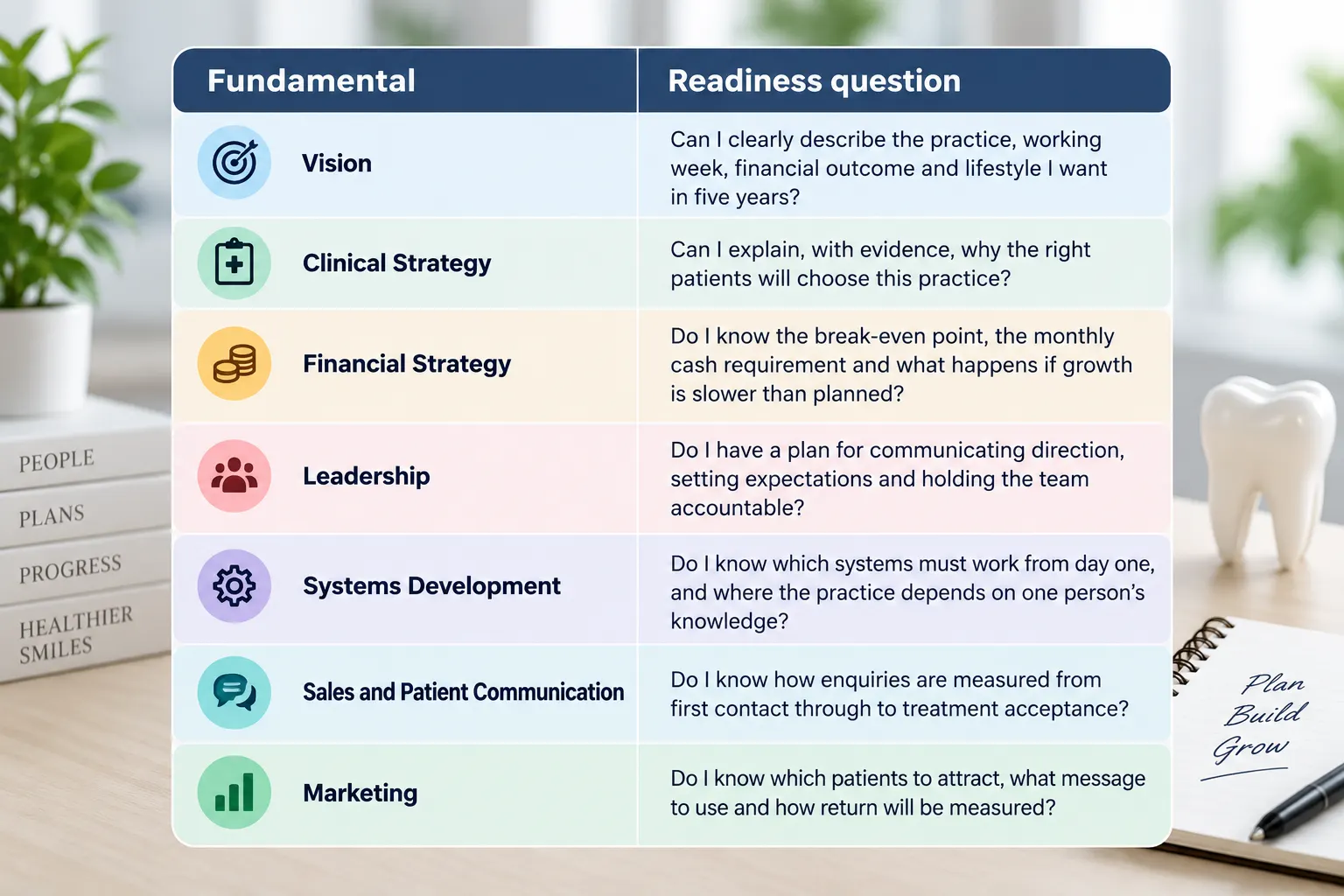
If several of these remain unclear, the answer isn't to rush ahead and hope they resolve after completion. It's to get the right business perspective before the decisions become expensive, difficult or impossible to undo.
Knowing how practices are valued also tells you what you are being asked to pay for. Our guide on what a dental practice is worth explains how the multiple is decided.
How Dental Wealth Builder supports the transition
Different stages call for different support. Preparing yourself as an associate isn't the same task as planning a purchase or leading a live practice through change.
The Associate Success Blueprint builds the foundations before ownership: mindset, communication, consultations, case acceptance, personal brand, commercial awareness and career planning. The Practice Growth & Success Programme gives dentists preparing to buy, build or grow a practice a structured route through ownership planning, systems, leadership, KPIs and implementation. High Performance Practice Business Coaching provides the deepest support when brand, marketing, team, systems, leadership, finances and growth plan all need to move forward together.
Dental Wealth Builder was created by dentists for dentists. Drs Rahul and Bhavna Doshi combine more than 30 years of clinical, practice ownership and business coaching experience. They've built, owned and sold practices, and coached dentists and practice owners through growth, leadership and ownership decisions.
The right starting point depends on your real constraint. Do you need to strengthen yourself as an associate first, build a credible plan for ownership, or implement change across a practice and team you already have? If you want an outside, experienced perspective on any of the seven fundamentals before you commit, book a Practice Growth Strategy Call with our team.
From associate ambition to responsible ownership
The move from dental associate to practice owner in the UK isn't complete when the purchase agreement is signed or the squat opens its doors. That's not the finish line. It's the point where ownership actually begins.
You don't need to know everything before you start. You do need a clear vision, reliable advisers, honest numbers and the willingness to grow from being responsible mainly for your own work into creating an environment where the whole practice can perform. That shift in responsibility is the real transition from associate to owner.
Of the seven fundamentals, which one could you answer with evidence today, and which one would you be guessing at?
Frequently asked questions on Transition from Dental Associate to Practice Owner
Should I buy an existing practice or build a squat as my first ownership move?
It depends on what you're solving for. Buying gives you patients, a team and a track record immediately, but the real risk is what changes once the seller leaves. Building gives you a blank page, but growth takes time and your plan has to survive that period financially. Neither is automatically safer, and both need all seven fundamentals answered with evidence.
What's the biggest mistake associates make when moving toward ownership?
Assuming clinical readiness is the same as business readiness. The costliest mistakes are rarely about dentistry. They're decisions about funding, team and systems made before the new owner has enough experience to see how those pieces connect.
Can I start preparing for ownership while I'm still an associate?
Yes, and it's the smarter route. Dr Shreyas Mhatre and Dr Sagar Shah both built the confidence, planning discipline and patient communication skills ownership demands while still working as associates, well before either considered buying a practice.
How much should I know about the practice's finances before buying?
Enough to independently explain the cash-flow assumptions and the downside scenario if growth is slower than expected. You need to know what's actually driving profit, rather than treating a bank's approval as reassurance that the numbers work.
Is leadership really that different from managing patients well?
Yes. Clinical skill is about your own performance. Leadership is about creating clarity, accountability and culture for other people, which formal dental training rarely covers. It's learnable, but it has to be built deliberately rather than assumed to arrive with the job title.
Useful official resources
- Care Quality Commission: Buy, sell or transfer a registered business
- General Dental Council: Standards and guidance
- Healthcare Inspectorate Wales: Register a private dental practice
- Healthcare Improvement Scotland: Independent healthcare registration
- Regulation and Quality Improvement Authority: Registration guidance
- GOV.UK: Write a business plan
Sources: DWB "Before You Buy or Build" prospect guide; Dr Shreyas Mhatre and Dr Sagar Shah case studies; Dr Sripal Kumar case study (dentalwealthbuilder.com/our-work/case-studies); Care Quality Commission, General Dental Council, Healthcare Inspectorate Wales, Healthcare Improvement Scotland and Regulation and Quality Improvement Authority guidance; GOV.UK business planning guidance.


05 Sep 26
Categories


Dr Rahul Doshi is a leading UK cosmetic dentist, entrepreneur and former Clinical Director of Dentex/PortmanDentex, with 25+ years of experience in dentistry and practice growth. As co-founder of Dental Wealth Builder, he helps dentists, practice owners and dental groups build profitable, scalable and high-performing businesses...Know more
Turn This Into a Plan for Your Practice
Reading is a start. The DWB Growth System turns it into a structured, step-by-step plan built around your practice, so you know exactly what to focus on first and why. No generic playbook, no pressure to sign up, just a clear path built for where you are right now.
About the Author

Dr Rahul Doshi
Dr Rahul Doshi, BDS (Lond.), LDSRCS (Eng.), is one of the UK’s most influential figures in cosmetic, comprehensive and business-led dentistry.
Widely recognised as one of the key dentists who helped introduce cosmetic dentistry to the UK over 25 years ago, Rahul is the founder of The Perfect Smile Studios and the Advanced Training Institute, where he trained dentists in Interdisciplinary Comprehensive Dentistry, including smile design, occlusion, treatment planning, full-mouth rehabilitation and advanced restorative care.
His experience extends far beyond clinical dentistry. Rahul has owned, led and scaled multiple award-winning dental practices, giving him first-hand insight into what it takes to build profitable, high-performing and team-led dental businesses. This practical experience now underpins his work with dental practice owners, multi-practice owners and dental groups who want to improve profitability, strengthen systems and scale with greater confidence.
Rahul has held several major leadership positions within the profession. As Clinical Director for Dentex Healthcare and later PortmanDentex, he helped support the growth and scaling of the group from inception to 185 practices, contributing strategic clinical leadership across one of the UK’s major dental organisations. He was also Clinical Director of the monthly dental publication Premium Practice Dentistry and a founding board member of the British Association of Private Dentistry.
A Past President of the British Academy of Cosmetic Dentistry, Rahul has been a long-standing judge for the Private Dentistry Awards and Dental Industry Awards. He has also been voted one of the UK’s Top 50 most influential dentists and recognised by his peers for his outstanding contribution to cosmetic dentistry.
As an inspirational national and international speaker, Rahul has lectured on cosmetic dentistry, smile makeovers, treatment planning, laser dentistry, leadership and practice growth across the UK, United States, UAE, Italy, India, Germany, Sweden and South Africa.
His work and expertise have been featured widely in national and international media, including the BBC, ITV, The Times, Daily Mail, The Guardian, Evening Standard, Marie Claire, Tatler and leading dental publications.
As co-founder of Dental Wealth Builder, Rahul now uses his rare combination of clinical excellence, entrepreneurial experience, multi-practice scaling and large-scale group leadership to help dentists, practice owners and dental groups build more profitable, scalable and rewarding businesses.